


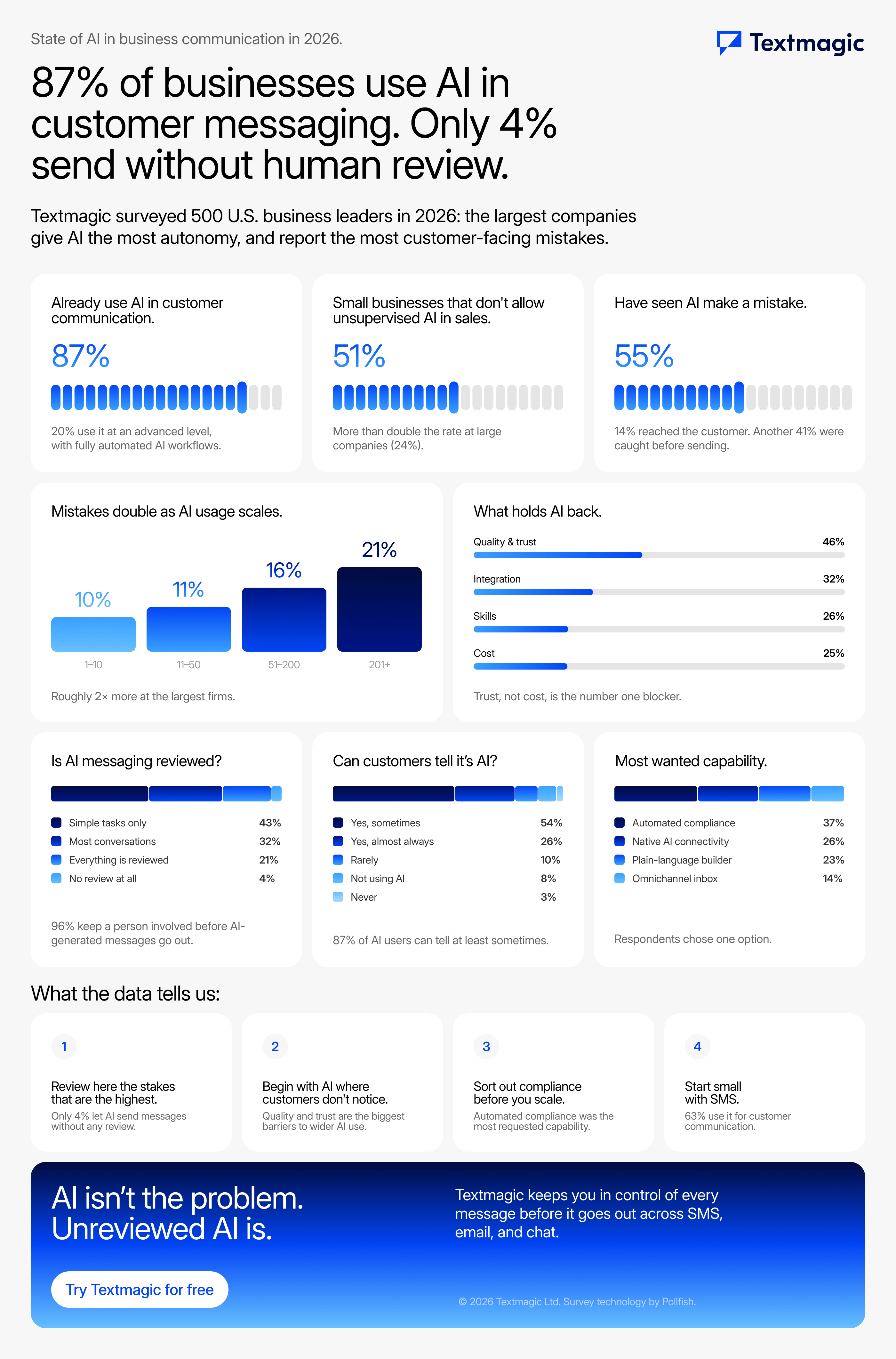
AI didn’t sneak into business communication. It walked through the front door, and 87% of business leaders let it in.
Trust is another matter. Half of small businesses (1-10 employees) keep AI out of sales entirely. Meanwhile large enterprises (201+ employees) give AI the most autonomy, but report twice as many customer-facing mistakes: 21% against 10%.
That’s what emerged when we at Textmagic surveyed 500 U.S. business decision-makers in August 2026: who’s using AI, who isn’t, what’s stopping them, and what goes wrong when they do.
Key takeaways:
- 87% of business leaders already use AI for customer communication, but only 4% allow it to send messages without human review.
- 51% of small businesses wouldn’t let AI handle sales conversations alone, more than double the rate at large companies (24%).
- Reported mistakes double from smallest to largest. Among businesses using AI in customer messaging, customer-facing errors run 10% at the smallest companies against 21% at the largest.
- Small businesses are four times as likely to use no AI: 34% against 8%.
- 46% say quality and trust hold them back from using AI more, nearly twice as many as cite cost. Small businesses point to a skills gap, while enterprises cite integration complexity and compliance.
- 45% of small businesses lack the technical staff to set up or manage AI workflows.
- Nearly nine in ten leaders using AI think customers can tell, at least sometimes, that they’re talking to a machine.
- Given one AI capability to add, 37% chose automated compliance support, ahead of options like native AI connectivity or an omnichannel inbox.
Most businesses have already got AI working
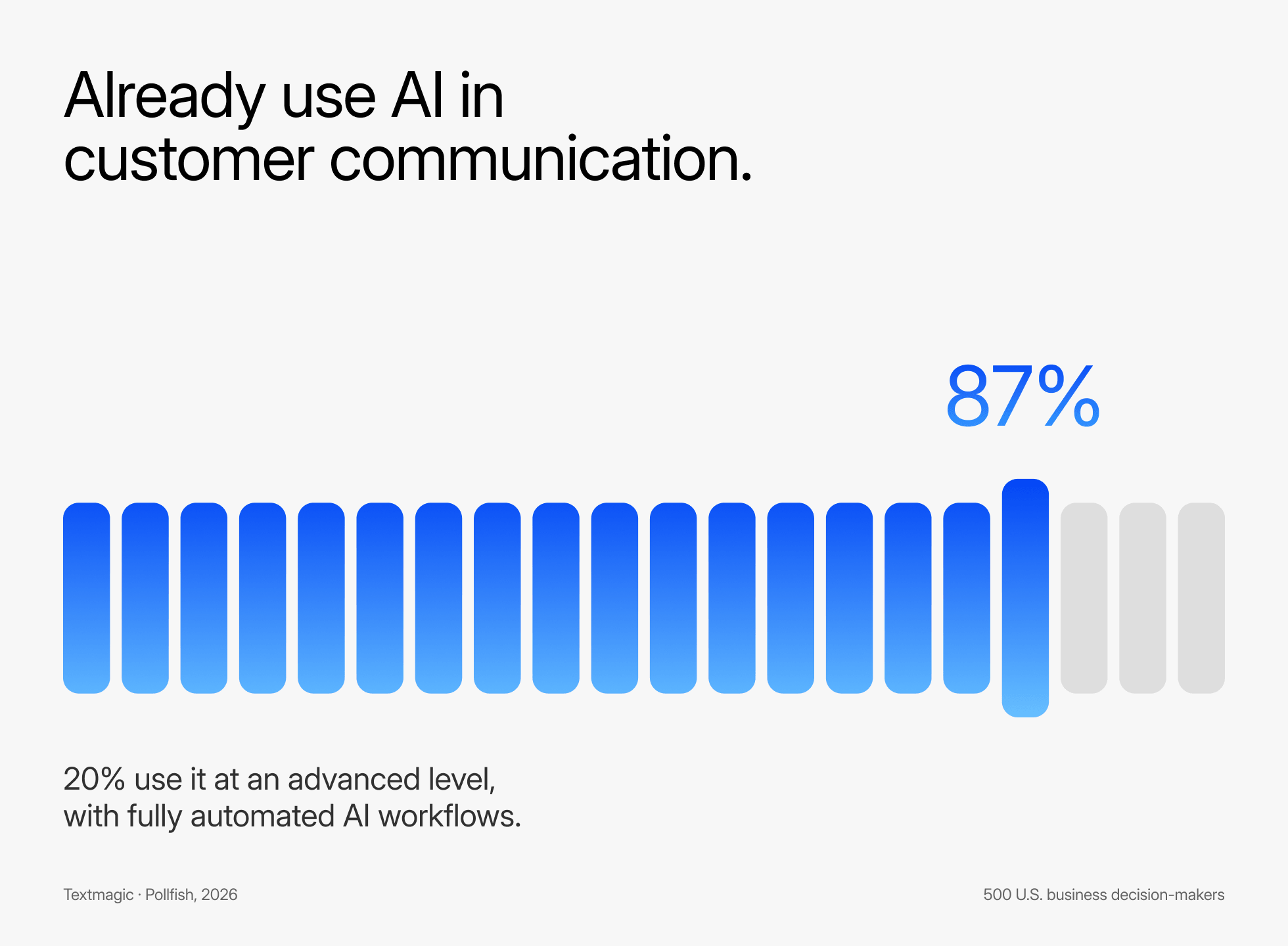
Adoption is no longer the question. Only 13% of the leaders we surveyed use no AI at all in customer or prospect communication. The rest have it doing something, even if that something is modest.
- 28% use AI occasionally, for drafting or brainstorming.
- 39% have basic automation running, like auto-replies or simple triggers.
- 20% describe their setup as advanced: fully automated AI flows built into their CRM or tech stack.
What that adoption actually looks like is telling. Drafting sales emails (55%), summarizing team conversations (52%) and first-line website chat (50%) lead the list. The top two have something in common: either a human still reads the output before anything reaches the customer, or the AI talks only to the team, not the customer.
Few trust AI with anything irreversible
The same pattern holds everywhere we asked about control. Only 4% of business leaders allow AI to send messages without any human review. The other 96% keep an eye on it. 43% limit AI to simple tasks like FAQs and order updates. 32% let it handle routine conversations, but escalate the rest. 21% review every single reply before it goes out.
Businesses have adopted AI enthusiastically for the parts of the job where mistakes are cheap, and held it back from the parts where they aren’t.
Confidence grows with size. Reliability doesn’t.
Here’s where the company-size data tells a story that the topline numbers hide.
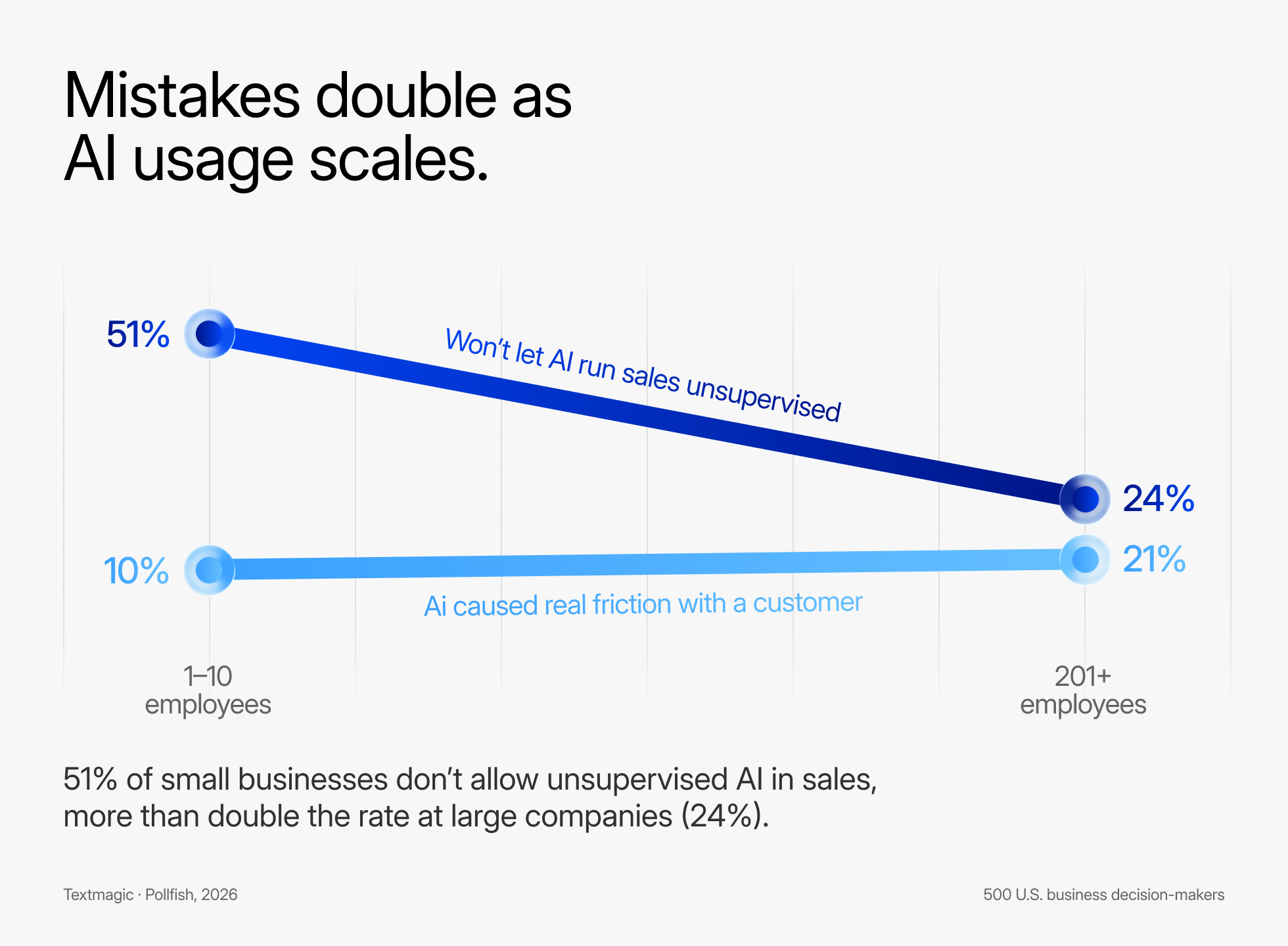
We asked leaders what is the biggest deal they’d let AI handle without a human reviewing it first. Among businesses with 1-10 employees, 51% said they wouldn’t let AI touch a sales conversation at all, whatever the deal size. At companies with 201+ employees, that falls to 24%. The bigger the business, the more willing it is to let AI operate where revenue is at stake.
You’d expect that confidence to be earned. The data doesn’t show it.
We also asked whether an AI tool had ever given a customer wrong information or mishandled a conversation. Raw rates climb with company size, but so does how often AI talks to a customer at all.
A business that keeps AI away from customers entirely can’t record a customer-facing mistake. Narrowing to businesses that let AI handle their direct messaging, the pattern holds:
| Company size | Reported AI caused real friction with a customer |
|---|---|
| 1-10 employees | 10% |
| 11-50 employees | 11% |
| 51-200 employees | 16% |
| 201+ employees | 21% |
That’s a 2x gap between the most cautious businesses and the least. Some of it is volume: a business running AI across thousands of conversations reaches its first incident sooner than one running it across fifty. But volume doesn’t explain the willingness. The companies handing AI the most autonomy are also the ones most likely to have been burned by it.
Overall, 55% of business leaders say an AI tool has given wrong information or mishandled a conversation at least once. 41% caught it before it reached the customer thanks to human review, 14% didn’t.
Even when AI gets the facts right, it rarely blends in. Among leaders whose businesses use AI, nearly nine in ten believe customers can tell, at least sometimes, when they’re talking to a machine and only 3% think customers can never tell. For the conversations where tone matters most, a sale, a complaint, a renewal, that’s one more reason to keep a person close.
Small businesses are being left behind, not just left cautious
The caution among small businesses isn’t only about trust. A lot of it is about resources they simply don’t have.
- 34% of businesses with 1-10 employees use no AI at all in customer communication, against 8% of companies with 201+ employees – a 4x gap.
- 45% of the smallest businesses have no dedicated engineering or technical staff to build or fix an AI workflow. Enterprises are more than 5x likely to deploy advanced AI automation: 22% against 4%.
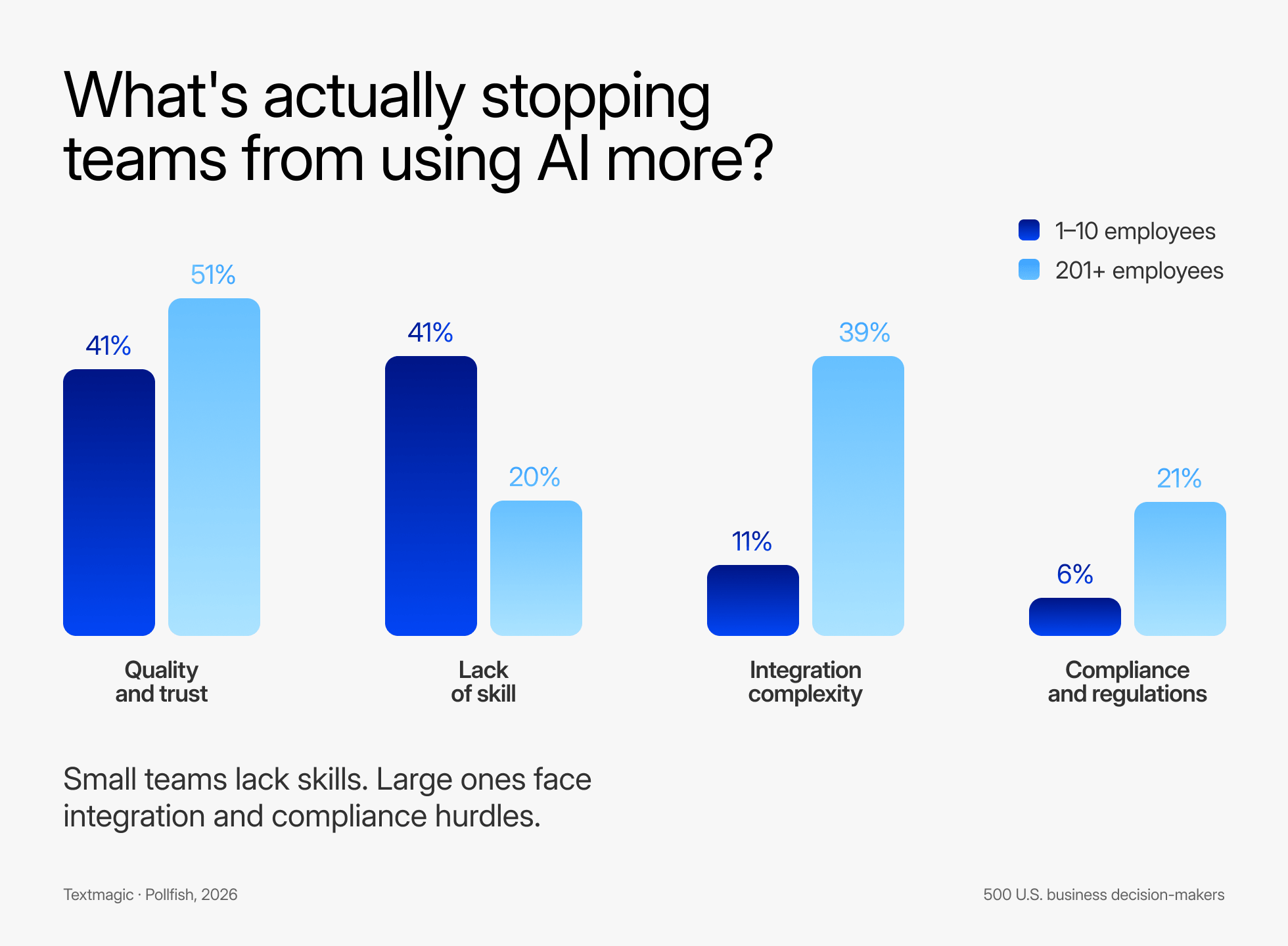
Asked what holds their teams back, 41% of small businesses cite a skills gap, compared to 20% of enterprises. Enterprises point to operational bottlenecks instead: integration complexity (39% over 12% at small firms) and compliance concerns (21% against 6%).
Small businesses aren’t holding back because they’ve decided AI isn’t for them. They’re holding back because it isn’t easy enough yet.
One channel bucks the trend: SMS. Small businesses lag far behind on website live chat as a customer channel – 11% against 54% at the largest companies. On SMS, the gap reverses: 63% of small businesses use it, against 57% of enterprises. If AI-assisted messaging is going to reach small businesses first, SMS is the likely channel.
What businesses want next
We asked leaders to rate four possible AI capabilities, then asked a sharper question: if you could only pick one, which would help the most right now?
The two questions produced different results, and the difference is the finding.
On a 5-point scale, a plain-language automation builder – describe the flow you want, instead of building a logic tree – came out on top, rated highly valuable by 53%. Native AI connectivity (50%) and automated compliance support (48%) followed close behind.
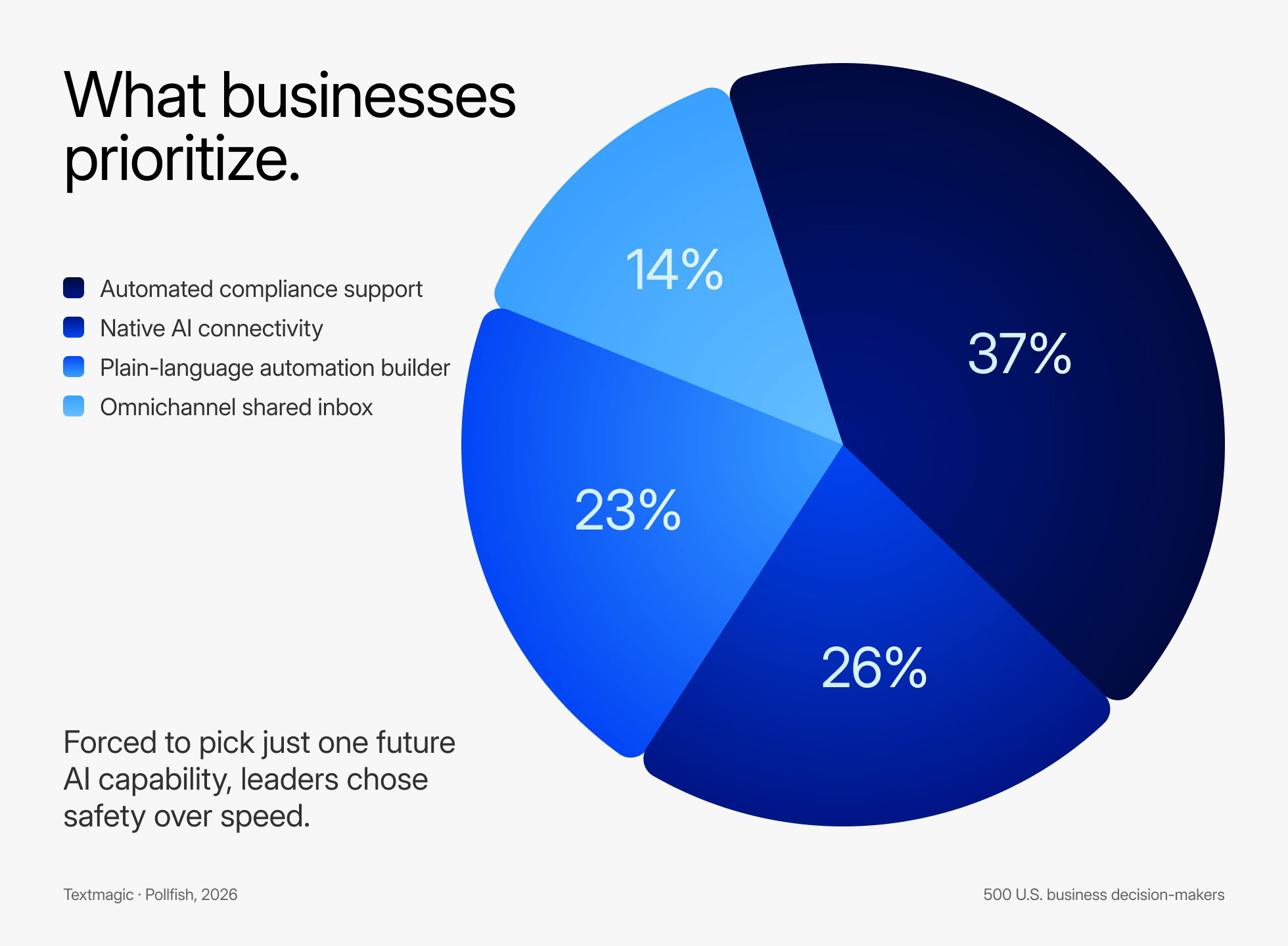
However, when forced to choose just one top priority, the ranking flips: 37% chose automated compliance support, well ahead of native AI connectivity (26%) and plain-language automation tools (23%).
Enthusiasm for AI features is broad. The actual priority is narrow: compliance. That tracks with everything else in this survey. Businesses aren’t asking AI to be more impressive. They’re asking it to be safer to use.
In their own words, a few business leaders put it more bluntly than any stat could:
I wish we could have more confidence in the AI. Customers still overwhelmingly want human communication when they’re spending their money, and I don’t blame them.
Solopreneur, 1-10 employees
Consistency is the number one thing I wish were easier when it comes to how AI handles my business communications which creates a lack of trust.
Freelancer, 1-10 employees
I wish it were easier to integrate AI across all our communication channels without losing context or needing constant manual oversight.
Business Manager, 200+ employees
What to actually do about it
The businesses getting this right decide in advance where AI stops. Four things the data supports, whatever your size.
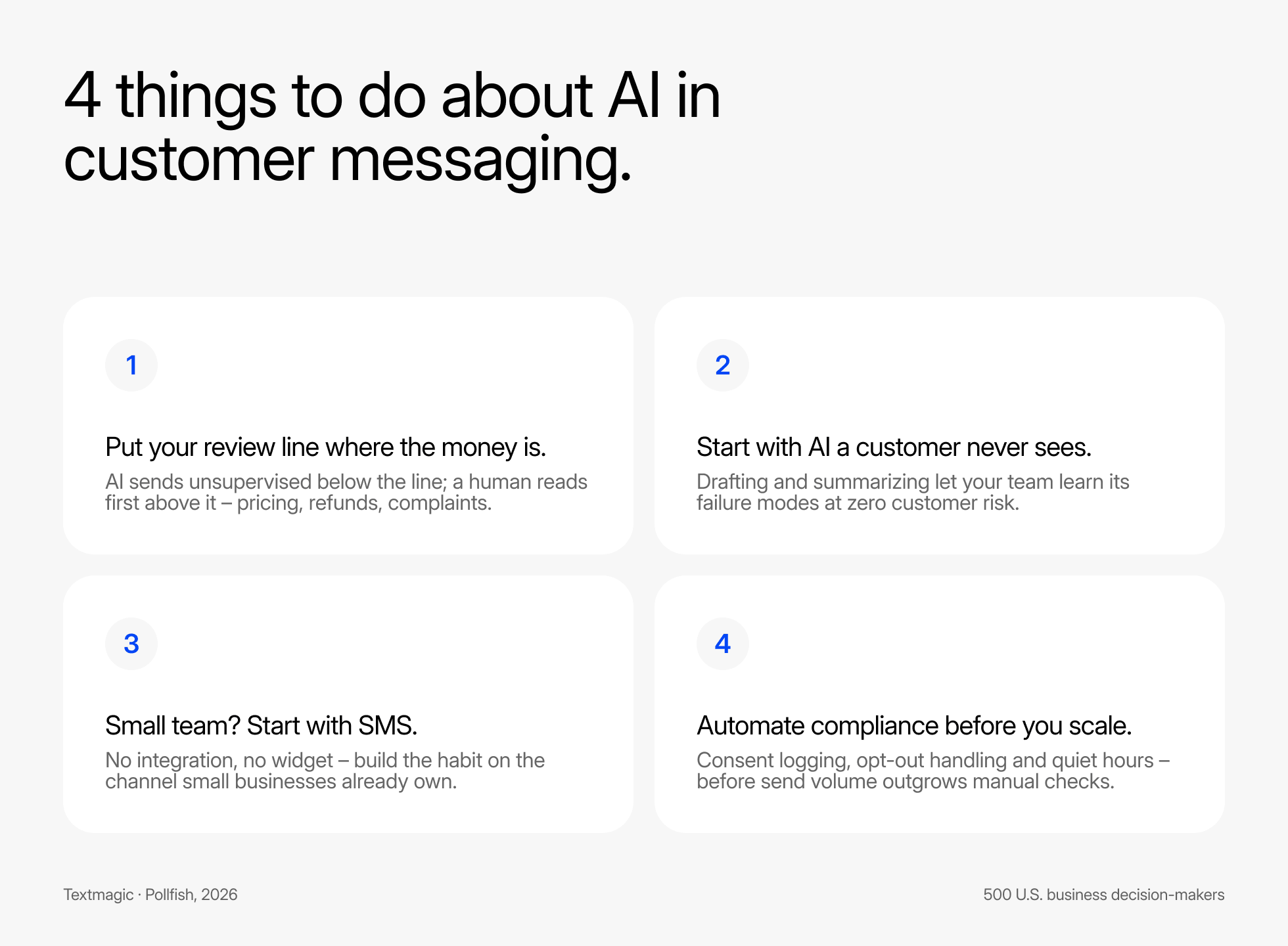
Put your review line where the money is
Human review isn’t overhead. Of the 55% of leaders whose AI tool got something wrong, three quarters caught it before it reached a customer. Review is what stopped it becoming a customer’s problem
Draw the line explicitly. Below it, AI sends unsupervised: order confirmations, delivery updates, hours and location. Above it, a person reads first: pricing, refunds, complaints, anything a customer might screenshot.
This is how Textmagic’s Point AI is built. It drafts the reply from your own knowledge base and gives it to a person who edits or sends.
Start with AI where a customer never sees the output
The most common uses in our survey, drafting sales emails, summarizing internal conversations, share a trait: nothing reaches the customer unedited. Internal-facing AI lets your team learn the tool’s failure modes on work where a mistake costs a redraft.
Textmagic’s shared inbox is a good place to start. AI drafts, the team reads and every conversation stays in one thread rather than scattered across individual phones.
Small team? Start with SMS
Small businesses name a skills gap, not cost, as the barrier. SMS sidesteps it: no site integration, no widget. And it’s the one channel where small businesses lead, at 63% adoption against 57% at enterprises.
It’s also where Textmagic’s AI automation flow builder can help. Describe the flow you want and it gets built, from operational to permission-based marketing: order updates, appointment reminders, quote follow-ups, team alerts, and opt-in campaigns. No logic tree, just easy templates.
And if your team already works in Claude or ChatGPT, Textmagic connects over MCP. Ask your assistant to send a message or pull up a contact, and it does. No new tool to learn.
Sort out compliance before you scale
Forced to choose one capability, 37% of leaders picked automated compliance support, the constraint everyone eventually hits.
Compliance errors scale with send volume: a consent gap that’s manageable at manual pace stops being manageable once a flow is running. Get consent logging and opt-out handling automated before you scale sending.
None of this is about AI getting smarter. It’s about AI getting safer to hand things to, and right now, that’s the gap most businesses are still closing.
Start with one flow. Automate the message your teams send most. Use the time it frees on the conversations that need a person.
Textmagic is free to try, with full access.
All the survey stats at a glance
Methodology
Textmagic conducted this survey via Pollfish in August 2026 via Pollfish among 500 U.S. business decision-makers (team or business managers and solopreneurs or freelancers), at companies ranging from 1 to 201+ employees. Individual contributors were excluded. All figures are raw response percentages unless otherwise noted.

Related articles

15 Effective follow-up email templates guaranteed to help you close more deals
Follow-up emails enhance business relationships and ...

How to use text messaging for event promotion and management
In the past years, getting the word out about an eve...

Mastering customer advocacy: 5 Strategies for business growth
Read our latest guide to find out how you can improv...

Actionable ways to use text messaging for debt collection
Be aware: In North America, sending such texts is st...

Create a winning B2B customer journey map: Guide & templates
Tips and templates to help you craft a winning B2B c...