


Choosing an SMS API is easy. Choosing the right one for your team is harder. Some platforms are built for developers who want complete control over messaging infrastructure.
Others give you a working messaging platform with API access on top. Most support the same core use cases, but the trade-offs around pricing, compliance, onboarding, and day-to-day operations are very different.
We evaluated 18 SMS APIs to help you pick the right one before you find out the hard way.
Written by Textmagic’s marketing and product teams, based on direct experience with SMS infrastructure and customer integrations. We are an SMS API provider ourselves, which means we have a bias, but it also means we know the space well enough to tell you honestly when a competitor is a better fit. All pricing was independently verified in June 2026 from each provider’s public pricing page or cross-referenced third-party reports where pricing is sales-gated.
Not sure where to start?
- Running reminders, alerts, or campaigns and need a platform your team can actually use? Start with Textmagic or ClickSend.
- Building OTP, notifications, or two-way messaging into an application? Start with Twilio, Vonage, or Telnyx.
- Operating at enterprise scale with millions of messages per month? Start with Sinch, Bandwidth, or Infobip.
- Already using a CPaaS provider and want a better interface without re-provisioning numbers? Look at Textmagic BYOC.
How we evaluated the best SMS API providers
Here’s what we looked at when evaluating SMS API gateways:
- Carrier connections. Owned network, partners, or intermediaries? This matters most at scale.
- Deliverability transparency. Are error codes detailed enough to diagnose failures in a timely manner?
- Compliance support. 10DLC, campaign vetting, TCPA guidance. Do they walk you through it or hand you a form?
- Geographic reach. US-only or global? How deep are the carrier relationships? Coverage on paper doesn’t mean reliable delivery.
- Developer experience. Documentation quality, SDKs, sandbox availability, and time to first message.
- Pricing transparency. The advertised rate rarely reflects what you pay. Surcharges, registration, and number fees can add 30–60%.
A note on pricing and SMS compliance
Every provider on this list charges per message segment, not per message. A standard SMS is 160 characters. If you go over that, it splits into multiple segments, each billed separately. Unicode characters (emoji, accented letters) reduce that limit to 70 characters per segment.
US carriers also add their own surcharges for commercial A2P messaging. Some providers absorb these; most don’t. All prices in this article are US-specific for simplicity. If you’re sending internationally, the relative differences between providers should hold across most markets.
On compliance: US A2P messaging requires registration. Most providers support 10DLC, toll-free, and short codes. 10DLC is the default for most businesses, toll-free offers higher throughput, and short codes are for very high-volume use cases.
TL;DR: Which SMS API should I choose?
The SMS API providers below are grouped by common use cases rather than ranked from best to worst. Use the recommendations above to jump directly to the providers most relevant to your team.
1. Twilio

Best for: Developer teams that need documentation quality, ecosystem breadth, and platform familiarity.
Twilio is the default starting point for most SMS projects. It has more Stack Overflow answers, third-party integrations, and engineers who’ve worked with it than any other provider on this list. If you’re hiring developers or building on existing tooling, that familiarity is valuable.
For SMS, most teams will use the Programmable Messaging API, which handles send/receive SMS, MMS, RCS with message scheduling, delivery tracking, and inbound webhooks. It’s mature, well-documented, and battle-tested. The Conversations API adds stateful threading across multiple, integrated channels, but at a higher cost. The Verify API handles 2FA across SMS, WhatsApp, and email.
Features at a glance:
- Channels: SMS, MMS, RCS (Programmable Messaging); SMS, MMS, RCS, WhatsApp, Messenger (Conversations API)
- Number types: 10DLC, toll-free, short code, alphanumeric sender ID
- Geographic coverage: 180+ countries
- Free trial and sandbox: 30-day trial with product-specific free units (e.g.100 SMS messages, 3,000 emails, and 75 voice minutes). A sandbox is available.
Pricing (verified on June 15, 2026):
- SMS outbound & inbound: from $0.0083/segment + carrier surcharge
- Phone number: $1.15/month (local), $2.15/month (toll-free)
- 10DLC setup: $46 one-time for Standard brands ($4.50 brand + $15 campaign for Low Volume Standard); campaign vetting $15
- 10DLC monthly: $10/month standard campaigns, $1.50/month low volume
- MMS: $0.022 outbound, $0.0165 inbound
- Conversations API: first 200 MAU (monthly active users) free, then $0.05/user/month + $0.25/GB media storage
2. Vonage

Best for: Enterprise teams that need telco-grade global infrastructure, or a single vendor contract across voice and SMS.
Vonage has a broad API portfolio. For SMS specifically there are two APIs worth mentioning. The SMS API is a dedicated SMS, MMS, and RCS endpoint. It’s clean, straightforward, and built for transactional and marketing SMS. It includes delivery receipts, multiple sender options, a compliance engine, and a built-in fraud defender.
The Messages API unifies SMS, MMS, RCS, WhatsApp, Facebook Messenger, and Viber under one endpoint. The two APIs both support two-way communication and have separate pricing models.
The Ericsson acquisition gave Vonage access to carrier-grade telco infrastructure and 5G Network API capabilities. Vonage also launched a Verified Workspace on the Postman API Network, giving developers a trusted, first-party source to explore and test Vonage APIs.
Features at a glance
- Channels: SMS, MMS, RCS (SMS API); SMS, MMS, RCS, WhatsApp, Facebook Messenger, Viber (Messages API)
- Number types: 10DLC, toll-free, short code, alphanumeric sender ID
- Geographic coverage: 200+ countries and territories
- Free trial: Yes. Sandbox with verified numbers, no credit card required
Pricing (verified on June 15, 2026):
- SMS outbound: $0.00809/segment + carrier surcharge
- SMS inbound: $0.00649/segment + carrier surcharge
- Phone number: $1.04/month (local), $1.75/month (toll-free), from $1,000/month (short code)
- 10DLC setup: ~$19.50 one-time ($4.50 brand + $15 campaign)
- 10DLC monthly: $10/month standard, $1.50/month low volume, $2/month sole proprietor
3. Textmagic

Best for: Businesses, agencies, and developers who need an SMS API that works for the whole team, not just engineering.
Most businesses sending SMS don’t need enterprise messaging infrastructure. They need messages to go out, replies to come in, and a system their whole team can use. Textmagic is built for businesses that need SMS to work without becoming messaging experts.
The REST API covers send/receive SMS, inbound callbacks, contact management, templates, scheduling, bulk sends, and delivery status. The platform (shared inbox, two-way chat, email campaigns, email-to-SMS, contact management) sits on top of the same account, available to non-technical teammates without a separate integration.
SMS pricing is simpler than most providers on this list: a flat per-message rate with free inbound SMS and no carrier surcharges added on top. 10DLC registration is handled through a guided flow with a built-in AI assistant that flags compliance issues before submission. Compliant SMS subscribe forms and policy documentation templates are included.
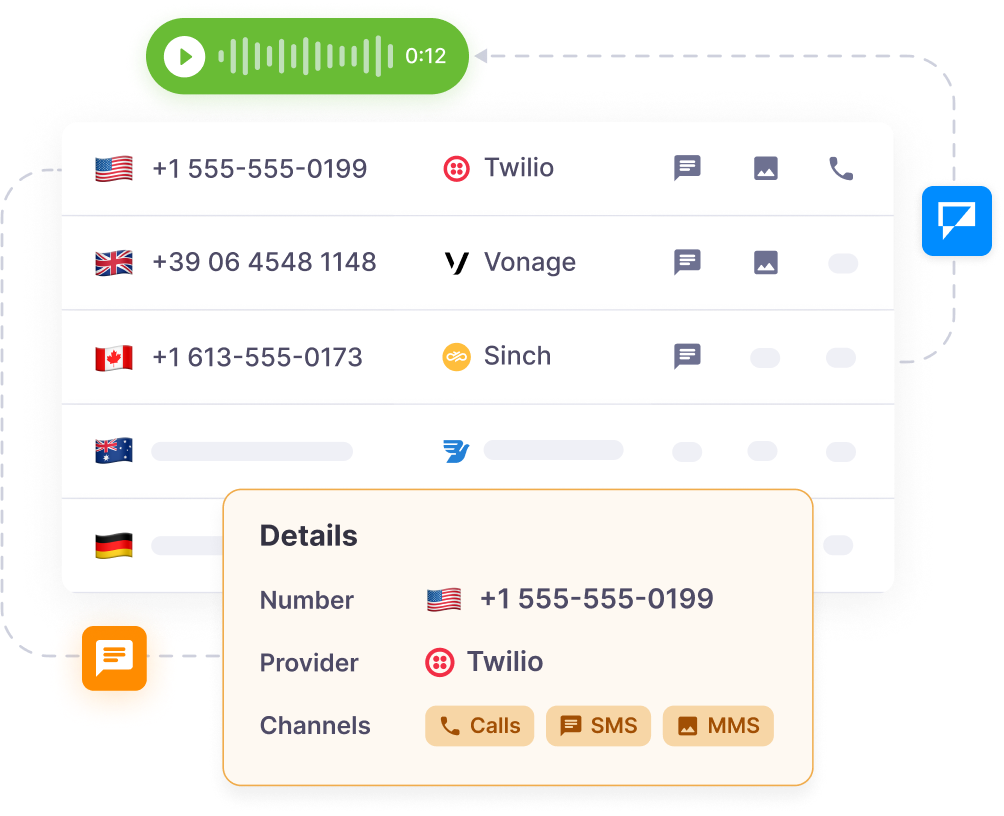
Bring your CPaaS number to Textmagic
Already on Twilio, Vonage, Sinch, or Bandwidth? Keep your number and rates — add our platform for $0.01/message.
Features at a glance
- Channels: SMS, MMS, Email, Email to SMS
- Number types: 10DLC, toll-free, alphanumeric sender ID, BYOC (Twilio, Vonage, Sinch, Bandwidth)
- Geographic coverage: US, UK, CA, AU, and 20+ other countries (see the Pricing page for full country list)
- SDKs: Node.js, PHP, Java, Python, .NET, Ruby, Go, Delphi, Perl, C++, Shell, C#
- Free trial / sandbox: Yes. Free credit on signup, no credit card required
Pricing (verified June 15, 2026)
- Outbound SMS: $0.049/message part, no surcharges
- Inbound SMS: free
- MMS: $0.08/message
- BYOC: $0.01/SMS part on top of your existing CPaaS rate
- Numbers: dedicated US numbers from $10/month; and sender IDs from £10/month
- Email: first 10,000/month free, then $0.003/email
- Credits never expire and Textmagic offers a 100% refund on unused credit. Support is responsive across all account sizes.
4. Sinch

Best for: Enterprises running global A2P at scale with strict compliance requirements and high sensitivity to SMS fraud.
Sinch (formerly CLX Communications) built its network through acquisitions and now maintains direct carrier relationships in more than 200 countries. This reduces reliance on intermediary providers, which can improve visibility and consistency when sending large volumes of international SMS.
One area where Sinch stands out is fraud protection. The platform actively monitors for SIM farms and artificially inflated traffic (AIT), where bad actors generate fake authentication requests or engagement to drive up messaging costs.
Sinch also handles much of the compliance work that comes with business messaging, including 10DLC registration, campaign vetting, and TCPA guidance. Beyond SMS, its Conversation API lets you manage customer communication across 14 channels such as WhatsApp, RCS, Viber, and Facebook Messenger through a single integration.
Features at a glance
- Channels: SMS, MMS (US, Canada, Australia, Puerto Rico) via SMS API; 14 channels via Conversation API
- Number types: 10DLC, toll-free, short code, alphanumeric sender ID, number import
- Coverage: 200 countries and territories, 600+ direct operator connections
- Free trial: Self-serve account available
Pricing (verified on June 15, 2026):
- SMS outbound/inbound: $0.0078/segment + carrier surcharge
- SMS outbound (short code): $0.009/segment + carrier surcharge
- Phone number: $1/month (10DLC), $2/month (toll-free)
- 10DLC setup: ~$4.00 brand registration, $40 to $95 for brand vetting (depending on standard vs. enhanced), and $2 to $10 for campaign registration
- 10DLC monthly: $30 upfront (first 3 months), then $10/month; low volume $1.50/month
- Short code: ~$1,000 one-time setup + $1,000–$1,500/month
5. Bandwidth

Best for: Large US enterprises with strict compliance requirements, 911 SMS needs, or regulated industries that need a genuine Tier-1 carrier.
Bandwidth is one of the few providers on this list that is also a carrier. While most SMS APIs rely on carrier partners somewhere along the delivery path, Bandwidth owns and operates its own Tier-1 US network. That gives it more direct control over reliability, compliance, and routing. For organizations operating in regulated industries or running business-critical messaging, that direct carrier relationship is a significant advantage.
The Messaging API supports SMS, MMS, and RCS through a single endpoint, with two-way messaging, delivery receipts, and traffic monitoring built in. A dedicated Registration Center also simplifies 10DLC and short code registration by automatically reusing brand and campaign information across messaging programs. Traffic monitoring gives proactive visibility into unregistered traffic and messaging health.
Features at a glance
- Channels: SMS, MMS, RCS (via Messaging API)
- Number types: 10DLC, toll-free, short code, alphanumeric sender ID, number porting
- Geographic coverage: 120+ countries (US Tier-1 owned network; international reach via carrier partnerships)
- Free trial: Trial available on request; no self-serve free tier
Pricing (verified on June 15, 2026):
- Outbound SMS: from $0.004/message segment + carrier surcharges
- Inbound SMS: free
- MMS: from $0.015/message segment
- Phone number: $0.35/month
- 10DLC campaign fee: $10/month standard, $1.50/month low volume
- Enterprise pricing via custom quote.
6. Infobip

Best for: Global enterprises and regulated industries (finance, healthcare, public sector) where direct carrier relationships, compliance tooling, and SLA guarantees are non-negotiable.
Infobip is built for organizations that need to communicate with customers across multiple countries, channels, and regulatory environments. With direct carrier connections in more than 190 countries, it’s a strong option for enterprises running global customer communications at scale.
The Messages API brings SMS, MMS, WhatsApp, RCS, email, voice, Viber, and other channels under a single platform. SMS can also be combined with Infobip’s broader suite of products for customer support, automation, campaigns, chatbots, and conversational experiences.
Where Infobip really stands out is compliance and risk management. The platform supports a broad range of certifications and regulatory frameworks, including GDPR, HIPAA, ISO 27001, and SOC 2. It also includes protection against artificially inflated traffic (AIT), a type of fraud that can generate significant costs for businesses sending large volumes of authentication or verification messages.
Features at a glance
- Channels: SMS, MMS, WhatsApp, RCS, Voice, Email, Viber
- Number types: 10DLC, toll-free, short code, alphanumeric sender ID
- Geographic coverage: 190+ countries
- SDKs: Java, C#, PHP, Go, Python, Flutter, Swift, React, Android, Cordova
- Free trial: Yes. 60-day free trial with free testing credits
Pricing (verified on June 15, 2026):
- US SMS: Pricing varies by destination and is published per country on the pricing page. Public estimates range from ~$0.0065 to $0.01 per US SMS.
- Numbers: can be purchased self-serve through the dashboard.
- Managed account options are available if you need dedicated support.
7. Telnyx

Best for: Cost-conscious developers sending high volumes who want the lowest per-message rate and direct carrier infrastructure without an enterprise sales cycle.
Telnyx operates a private, cloud-agnostic IP network across 40+ countries. This SMS API has become one of the most popular alternatives to Twilio for teams that care about messaging costs. Unlike many enterprise-focused providers, volume discounts are applied automatically as you scale, without requiring a sales conversation.
The developer experience of Telnyx is strong. The API is well documented, self-serve, and easy to test, while Mission Control provides a clean interface for managing numbers, messaging, and account settings without leaving the platform. Telnyx also offers one of the most transparent pricing models on this list, making it easier to estimate costs before committing.
Telnyx claims customers typically save 30–70% compared to Twilio. While the exact number depends on your traffic patterns and use case, our analysis also supports the broader point: it’s a good choice if your primary constraint is cost and you’re sending US SMS at volume with a developer-led team.
Features at a glance
- Channels: SMS, MMS, RCS, WhatsApp
- Number types: 10DLC, toll-free, short code, alphanumeric sender ID
- Geographic coverage: private owned network in 40+ countries; SMS reachable in 180+ countries via carrier partnerships; local numbers available in 140+ countries
- Free trial / sandbox: Self-serve, no minimum commit, no dedicated sandbox
Pricing (verified on June 15, 2026):
- 10DLC outbound & inbound: from $0.004/segment + carrier surcharge
- Toll-free outbound & inbound: from $0.0055/segment + carrier surcharge
- Short code outbound & inbound: from $0.007/segment + carrier surcharge
- US RCS: from $0.0065/segment
- MMS: outbound $0.015 + carrier surcharge; inbound: $0.005
- Numbers: from $1/month + $0.10/month SMS add-on; short codes from $1,000/month
- 10DLC setup: $4.50 brand registration + $15 campaign review = $19.50 one-time (no standard vetting fee listed)
- 10DLC monthly: $30 upfront (first 3 months), then $10/month; low volume $1.50/month, charity $3/month, emergency $5/month
- Volume discounts: automatic tier drops
8. Bird

Best for: Teams that want a single platform for SMS, email, and WhatsApp with strong global and European coverage.
Bird has evolved from a messaging provider into a broader customer communications platform. The Channels API brings SMS, WhatsApp, email, voice, RCS, and other channels together under a single integration, making it a strong option for teams that want to manage customer communication across multiple channels without stitching together separate vendors.
With direct carrier connections across 140+ countries and particularly strong European coverage, Bird is worth evaluating for businesses with international sending needs.
Note that Bird now advertises two distinct pricing models: a per-message connectivity rate for API users, and contact-based platform with annual uprfont contract for marketing and CRM use cases.
Features at a glance
- Channels: SMS, WhatsApp, Facebook Messenger, Instagram, Line, RCS, Voice
- Number types: local, national, and toll free numbers, sender IDs, short codes
- Geographic coverage: 140+ countries
- Free plan: Yes, 10 free credits
Pricing (verified on June 15, 2026):
- US outbound SMS: $0.0074/message (API/connectivity rate)
- Platform plans: from $45/month for 3,000 contacts (unlimited sends; SMS fees apply on top)
- 10DLC setup: $19.50 one-time ($4.50 brand + $15 campaign)
- 10DLC monthly: $10/month standard, $1.50/month low volume
- Carrier surcharges apply on top
9. ClickSend

Best for: Teams that want straightforward bulk SMS and transactional messaging without enterprise CPaaS complexity.
ClickSend focuses on doing the fundamentals well. The platform covers the most common business messaging use cases: appointment reminders, notifications, OTPs, and two-way customer communication, without the complexity of larger CPaaS providers.
The developer experience is straightforward, with clear documentation, extensive Postman collections, and a simple API that can be implemented quickly. For businesses that need SMS functionality rather than messaging infrastructure expertise, ClickSend is often easier to evaluate and deploy than providers like Twilio.
A notable feature is the ability to verify and send SMS from an owned number in supported countries, though this doesn’t replace US compliance requirements like 10DLC registration or toll-free verification.
Features at a glance
- Channels: SMS, MMS
- Number types: 10DLC, toll-free (US), own numbers, shared numbers, sender IDs
- Geographic coverage: 220+ countries and territories
- Free trial / sandbox: Yes. 14-day trial period with testing credit
Pricing (verified on June 15, 2026):
- US outbound SMS: $0.0282/message at entry tier, down to $0.0081 at 150,000+ messages
- Carrier surcharge: flat $0.003597/SMS regardless of carrier or number type
- Inbound SMS: free
- MMS: $0.0374/message
- Dedicated numbers: from $3.53/month; short codes from $1,059.60 setup + $1,236.20/month
- No monthly fees, no contracts, credits do not expire
SMS APIs we reviewed and didn’t include
- Plivo: still offers an SMS API, but recent product launches have focused heavily on AI voice agents.
- AWS End User Messaging: viable for AWS-native teams; better options exist for standalone SMS
- Messente: strong northern EU carrier relationships; requires 500 EUR minimum spend and a sales conversation to get started
- RingCentral: SMS is bundled with a UCaaS suite, not available as a standalone API
- SimpleTexting: acquired by Sinch; API access is approval-gated
- SlickText: US and Canada only; credits-based pricing without per-message rate transparency
- CM.com: Dutch CPaaS, 60+ direct carrier connections, 250 operator networks. Strong in Europe. SMS Gateway API + separate APIs for RCS, WhatsApp, Viber.
- Essendex: UK-based (owned by Commify), 190+ country coverage, solid API docs. No dedicated US site but covers US traffic. Good choice for UK/EU-primary team
- D7 Networks: Global coverage, competitive pricing, EU-friendly. Worth evaluating for international bulk SMS without enterprise minimums.
Wrapping up
The best SMS API isn’t necessarily the one with the most features, the lowest rates, or the largest carrier network. It’s the one that fits the way your team works.
If you’re building messaging infrastructure, providers like Twilio, Telnyx, Sinch, and Bandwidth offer powerful foundations. If you need a platform that combines SMS delivery with the tools your team uses every day, solutions like Textmagic and ClickSend may get you to value faster.
Most SMS APIs can send a message. The real question is how much of the work around messaging you want to build, manage, and maintain yourself.
Need an SMS API your whole team can use?
Textmagic combines SMS infrastructure with the inboxes and workflows businesses use every day.
SMS API FAQs
An SMS API is an HTTP endpoint that accepts a destination phone number, a message body, and a sender identifier, then routes the message through carrier infrastructure to the recipient’s handset. It abstracts the underlying SMPP protocol, number provisioning, compliance registration, and delivery receipt handling behind a REST interface.
Most providers offer trial credits or sandboxes. Textmagic offers a sandbox and free credit with no credit card required. Twilio gives product-related trial credits. Vonage provides a sandbox with verified numbers and no credit card required. Telnyx is fully self-serve with no minimum commit. ClickSend gives free test credit on signup.
Depends on use case and geography. Bandwidth has the highest published US SLA at 99.996% backed by owned network infrastructure. Twilio is the most battle-tested across the widest range of traffic types. For most teams the bigger reliability risk is unregistered 10DLC traffic being filtered, which is a compliance issue, not an API stability issue.
Create an account, get API credentials, provision a phone number, register for 10DLC if sending A2P to US numbers (mandatory in 2026), then POST to the messages endpoint with credentials, from/to numbers, and message body. Handle delivery receipt webhooks to confirm status. Most providers have SDKs for Python, Node.js, PHP, Ruby, Java, and Go.
An SMS gateway translates between internet protocols (HTTP/SMTP) and carrier networks (SS7/SMPP). An SMS API is the developer-facing REST interface built on top. In vendor documentation the terms are used interchangeably.
10DLC (10-Digit Long Code) is the US framework for A2P business messaging on standard local numbers. Registration with The Campaign Registry has been mandatory since 2021. Unregistered traffic is filtered at the carrier level in 2026. US-specific. Canada has a separate scheme. Most other countries use different frameworks.

Related articles

Top 10 changelog examples & why it’s important to showcase product changes
If you’ve ever launched or managed a product, then y...

Effective lead nurturing strategies with SMS marketing
Our phones have become an integral part of our daily...

13 Black Friday marketing ideas to boost sales using SMS
Black Friday is one of the biggest shopping holidays...

Canadian texting service: Mastering SMS compliance for effective communication
Texting in Canada comes with its own laws you must a...

15 Brilliant cold email templates guaranteed to get you more sales
Have you ever used cold email templates and received...